
André
Prinsloo
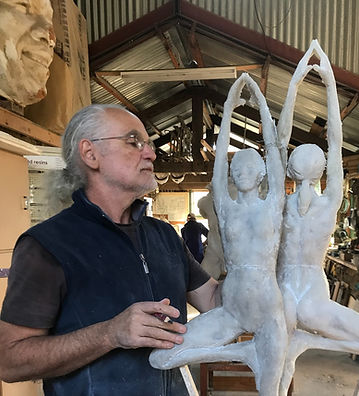
Artist Statement
My work is not conceptual but often an emotional response to the world that I experience. Human relationships, problems and emotions find expression through the human figure. The construction of the internal armature is part of the sculpture’s creative journey leading to the shapes and forms in space – line and volume. At some point during this process the work takes on a life of its own. At this point the dialogue between me and the sculpture begins. This is almost the only reason why I sculpt – this inner exploration of my relationship to the world that I find myself in.
The creation of my sculptures is a very private act that originates from deep within my sub-conscience. Often the idea just happens without much conscious thought. Verbal communication – especially with strangers, does not come naturally to me. Thus sculpture – like music, has become my universal language. In the act of creation, I therefore talk to myself. It has become a way of exploring my inner emotions. There are many ways in which I can start a sculpture. Usually, movement is the spark that inspires, but lately just a simple stillness (as in yoga pose) can also be the trigger. As humans we can all identify with the emotions and feelings irrespective of our backgrounds. Therefore, the human form has become my universal language in which I prefer to express myself. The extreme poses portray extreme emotions. The figures are often androgynous. Often, when I start sculpting, the rhythm, feeling and line are the important factors. Only towards the end do I have to decide on a gender and by then usually the sculpture itself has determined its own gender.
Each sculpture has its own persona. It might change as work progresses and it is one of the reasons why I find it difficult to name my sculptures. It eventually will also be interpreted differently by each viewer.
Sculpture is an integral part of my life and the unspoken language in which I express my own humanity. As the nature of sculpture is three-dimensional it therefore intrudes into our living space and becomes a lot more intimate by nature. It is tangible and the sensation of touch is one of our most important senses. Everybody enjoys touching or being touched by those dear to us.
I find the duality of bronze as a medium fascinating. During the actual casting there-of it is hot and liquid as water. Once cast it becomes cold and hard. The sculptor’s art is to understand this medium and to create shapes and textures that will still entice the viewer to reach out and touch the warmth and softness that is captured within the work. When and if you the viewer touch my work, I have been successful to communicate with you despite our various backgrounds.
Contrary to a painting, a photograph or a drawing that has its own built-in source of light captured by the artist, a sculpture’s light source continually varies according to its physical circumstances. Sometimes the surface is smooth and other times impressionistic – each reflecting light in a different way (hard or soft).
Another important factor is that a sculpture’s rhythm and line must be able to stand on its own without needing a patina to make it “pretty” and acceptable. I would ideally like to naturally age my work over a period of months or even years to develop its own character/patina. But today’s society is one of instant gratification and thus the use of chemical patinas.
As with people, no two works are alike even though they might be editions of the same work. The nature of lost wax casting ensures that all works are unique.
Enough said about my view on my works – let them now speak for themselves…
Biography
Born 8 November 1956 in Gqeberha / Port Elizabeth, Eastern Cape, South Africa
“Figurative Art describes artwork - particularly paintings and sculpture - that is clearly derived from real object sources, and therefore by definition representational. Figurative Art is often defined in contrast to Abstract Art.
Since the arrival of abstract art, the term figurative art has been used to any form of modern art that retains strong references to the real world.
The formal elements, those aesthetic effects created by design, upon which figurative art is dependent, include line, shape, colour, light and dark, mass, volume, texture, and perspective. These elements are used to create an impression or illusion of form and space. Usually, to create emphasis on the narrative portrayed.
Figurative art is itself based on an understanding of abstracted shapes: the figure sculpture of Greek & Egyptian antiquity was not naturalistic, for its forms were idealized and geometric. Idealization gave way to observation, and figurative art which balanced ideal geometry with greater realism was created.”
Above is a quote from an unknown source that I, as an artist and sculptor, finds particularly true to my vision.
I have a deep respect for the fundamental craft of sculpture, a tradition that transcends cultures and historical periods. The distinction often drawn between art and craft has held little relevance in many societies, and I believe that debate has largely run its course. The word art derives from the Latin ars, meaning skill or craft, reflecting a time when artistic excellence and mastery of craftsmanship were inseparable.
My artistic journey began with painting and drawing, but I soon discovered that sculpture offered a more profound connection to my creative instincts. The physical engagement with materials - the direct act of making - resonated deeply with me.
Through sculpture, I found a language uniquely suited to exploring the human experience. The figure, through gesture, movement, and presence, can communicate thoughts and emotions that transcend words. My work therefore centres on the human form, using it as a vehicle for reflection on our common humanity. By avoiding overt symbolism and narrative devices, I seek to allow the figure itself to speak, inviting viewers to bring their own experiences and interpretations to the work.